
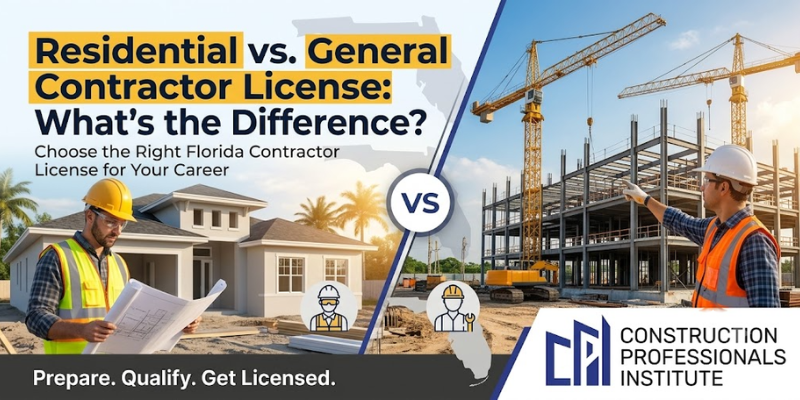
If you’re planning a career in the construction industry, understanding the difference between a Florida, Residential Contractor License and a General Contractor License is one of the most important decisions you’ll make. Both licenses open doors to rewarding opportunities, but they differ significantly in the type of work you can perform, the projects you can manage, and your long-term career potential.
Whether you’re an aspiring contractor or an experienced builder looking to expand your qualifications, this guide explains everything you need to know about obtaining a Florida Contractor’s License and choosing the right licensing path.
At Construction Professionals Institute, we help future contractors prepare for licensing exams, understand state requirements, and build successful careers in Florida’s thriving construction industry.
What Is a Florida Contractor License?
A Florida Contractor License is issued by the Florida Department of Business and Professional Regulation (DBPR) and allows qualified individuals to legally perform construction work within the state.
Depending on your career goals, you may choose between several contractor classifications, with the two most common being:
- Residential Contractor License
- General Contractor License
- Building Contractor License
Choosing the appropriate license depends on the type of construction projects you intend to undertake.
What Is a Residential Contractor License?
A Residential Contractor License authorizes contractors to construct, remodel, repair, or improve residential buildings.
Typically, residential contractors can work on:
- Single-family homes
- Duplexes
- Townhomes
- Small residential buildings
- Home additions
- Kitchen remodels
- Bathroom renovations
- Roofing
- Garages
- Outdoor living spaces
Residential contractors focus exclusively on residential construction and cannot oversee many commercial or large-scale building projects.
What Is a General Contractor License?
A General Contractor License provides much broader authority.
Licensed general contractors can manage:
- Residential construction
- Commercial buildings
- Multi-story structures
- Industrial facilities
- Government projects
- Large renovations
- Infrastructure improvements
- Mixed-use developments
Because of its wider scope, becoming a Florida General Contractor provides greater flexibility and significantly expands career opportunities.
Residential vs. General Contractor License
Understanding the differences helps you choose the right career path.
| Residential Contractor | General Contractor |
| Residential projects only | Residential and commercial projects |
| Limited project scope | Broad construction authority |
| Smaller construction jobs | Large-scale developments |
| Lower earning potential | Higher income opportunities |
| Ideal for home builders | Suitable for contractors managing diverse projects |
If your long-term goal includes commercial construction, a Florida General Contractor License offers considerably more opportunities.
Scope of Work
Residential Contractor
Residential contractors generally perform work involving:
- Home construction
- Remodeling
- Home repairs
- Deck construction
- Home additions
- Roofing
- Interior renovations
Their work is limited to residential occupancy.
General Contractor
A Florida General Contractor can oversee:
- Office buildings
- Shopping centers
- Hotels
- Warehouses
- Schools
- Residential communities
- Apartment complexes
- Government facilities
General contractors often coordinate multiple subcontractors and manage larger construction budgets.
Career Opportunities
One of the biggest differences between the two licenses is career growth.
With a Residential License, you may work primarily in:
- Home building
- Residential remodeling
- Local renovation companies
- Small construction businesses
With a Florida General Contractor License, opportunities expand into:
- Commercial construction firms
- Large infrastructure projects
- Property development
- Construction management
- Government contracts
- Independent contracting
Many experienced residential contractors eventually pursue a General Contractor License to grow their business.
Income Potential
Generally, contractors with a Florida General Contractor License have greater earning potential because they can bid on larger and more diverse projects.
Factors affecting income include:
- Experience
- Specialization
- Business size
- Project complexity
- Geographic location
The broader the scope of work you’re licensed to perform, the greater your opportunities for higher-value contracts.
Requirements for General Contractor License in Florida
Meeting the Requirements For a General Contractor License In Florida involves several important steps.
Applicants generally need to satisfy requirements related to:
Experience
Applicants typically need qualifying construction experience demonstrating their ability to supervise and manage projects.
Examination
Candidates must successfully complete the required licensing examinations covering construction knowledge, business, and finance.
Financial Responsibility
Applicants must demonstrate financial stability and may need to meet credit or insurance requirements depending on their circumstances.
Insurance
General contractors are expected to maintain appropriate insurance coverage to protect clients, employees, and businesses.
Application Approval
After meeting all eligibility requirements, applicants submit documentation to the Florida licensing authority for review and approval.
Understanding these requirements early helps ensure a smoother licensing process.
How to Choose the Right License
Consider these questions:
Do you only want to build homes?
A Residential Contractor License may meet your needs.
Do you want to work on commercial projects?
Choose the Florida General Contractor License.
Do you plan to grow your construction business?
A General Contractor License offers greater flexibility.
Do you want higher income opportunities?
General contractors generally have access to more profitable contracts.
How Construction Professionals Institute Can Help
Preparing for licensing exams requires more than simply reading textbooks.
Construction Professionals Institute provides comprehensive training designed to help future contractors understand construction principles, licensing requirements, business practices, and exam preparation strategies.
Students benefit from:
- Experienced instructors
- Structured exam preparation
- Practice examinations
- Flexible learning options
- Business and finance preparation
- Guidance throughout the licensing process
Whether you’re pursuing your first Contractor License in Florida or upgrading your qualifications to become a Florida General Contractor, professional preparation can significantly improve your confidence and exam readiness.
Tips for Passing Your Contractor Licensing Exam
Success starts with proper preparation.
Helpful strategies include:
- Study consistently.
- Use updated learning materials.
- Practice time management.
- Complete mock examinations.
- Review Florida construction regulations.
- Strengthen business and finance knowledge.
- Attend professional training programs.
A structured study plan greatly increases your chances of passing the exam on your first attempt.
Why Becoming a Florida General Contractor Is Worth It
Florida continues to experience strong growth in residential, commercial, and infrastructure development.
Obtaining a Florida General Contractor License allows you to:
- Expand your business
- Increase earning potential
- Bid on larger projects
- Work across multiple construction sectors
- Build long-term career stability
- Establish professional credibility
As Florida’s construction industry continues to grow, licensed contractors remain in high demand.
Conclusion:
Choosing between a Residential Contractor License and a Florida General Contractor License depends on your career goals, the type of projects you want to manage, and your long-term business plans. While a Residential License is an excellent choice for professionals focused on home construction and remodeling, a General Contractor License provides the flexibility to work on both residential and commercial projects, opening the door to larger contracts and greater earning potential.
If you’re ready to advance your career and obtain your Florida Contractor License, Construction Professionals Institute offers the education, training, and exam preparation needed to help you succeed. With expert guidance and comprehensive learning resources, you can confidently prepare for your licensing exam and take the next step toward becoming a successful licensed contractor in Florida.
Frequently Asked Questions (FAQs)
1. What is the difference between a Residential Contractor License and a Florida General Contractor License?
A Residential Contractor License allows you to work on residential construction projects only, while a Florida General Contractor License permits you to manage both residential and commercial construction projects.
2. Who should apply for a Florida General Contractor License?
Anyone planning to oversee commercial construction, large residential developments, or expand their construction business should consider obtaining a Florida General Contractor License.
3. What are the requirements for a General Contractor License in Florida?
The Requirements For General Contractor License In Florida generally include qualifying construction experience, passing the required examinations, meeting financial responsibility standards, obtaining appropriate insurance, and completing the state licensing application process.
4. Is a Florida General Contractor License better than a Residential License?
Neither license is inherently better; it depends on your goals. However, a Florida General Contractor License offers a broader scope of work and greater career flexibility.
5. How can Construction Professionals Institute help me obtain my Florida Contractor License?
Construction Professionals Institute provides professional exam preparation, experienced instruction, practice tests, and comprehensive study resources designed to help students successfully earn their Contractor License Florida.
6. Can I upgrade from a Residential Contractor License to a Florida General Contractor License?
Yes. Many contractors begin with residential licensing and later pursue a Florida General Contractor License as they gain experience and wish to expand into commercial construction and larger-scale projects.